

When investment managers switch custodians, attention typically centers on the transition logistics—system integration, compliance considerations, and client communications. Less often discussed is what can be left behind: years of trading history, now fragmented across multiple systems. It’s an operational gap that quietly erodes data lineage until the downstream effects become too costly to ignore.
Custodian transitions are one symptom of a broader data challenge for operations teams. Investment firms face increasing complexity across data sources, from custodians and fund administrators to transfer agents and market data providers. Meanwhile, they are navigating a wider investment product mix alongside greater regulatory pressure around reporting and valuation governance.
In many cases, infrastructure has not kept pace with these broader changes. Historical data retrieval is costly and slow, often requiring direct client involvement, while disjointed refresh cycles and manual reconciliation create a fragmented view of investment data with unclear ownership.
Collectively, these challenges create hidden costs and liabilities for investors:
Operational drag from maintaining and reconciling data across systems
Governance gaps as oversight spreads across systems and providers
Missed class action recoveries when claim filings rely on incomplete trading data
While each of these risks carries an element of fiduciary responsibility, class action exposure can be easy to overlook because negative outcomes may not become apparent until years later. In some cases, however, the consequences can be immediate.
Consider custodian transitions. The historical holdings needed to submit accurate class action claims may sit with a former provider that has no obligation to support filing once the relationship ends—nor would it be reasonable for a bank to assume liability for data outside its current custody. Meanwhile, an incoming custodian is unlikely to assume responsibility for legacy data it did not generate and cannot independently verify. The result is a sudden fiduciary gap for the firm.
A single book of record for class action data, supported by scalable technology and repeatable processes, creates operational alpha for investors by helping ensure eligible shareholder recoveries are captured efficiently—not left on the table.
Operational Alpha in Practice
The financial stakes of fragmented class action data can be significant. Over the past three years (2023-25), shareholders recovered more than $16 billion across hundreds of settled securities cases. In January 2026 alone, four new securities settlements totaling $1.4 billion were announced. Investment managers with public equity allocations often have material exposure, yet their recovery outcomes are heavily dependent on transaction data quality and access to trade substantiation records.
A recent surge in fraudulent class action claim filings has raised the bar for proving eligibility. High-loss claims are more likely to be audited by case administrators, leaving investors less time to resolve discrepancies flagged in their claim data. Investors attempting to participate in SEC Fair Funds—agency enforcement actions with stricter eligibility requirements than securities class actions—must provide full, original documentation for all trades included in their claim submissions or risk rejection.
Building a consolidated view of class action exposure is not only critical to protecting shareholder entitlements in securities cases, but it also transforms what is historically viewed as a back-office obligation into an alpha generator. FRT analysis of a firm’s existing class action footprint routinely reveals missed recoveries or sub-optimal claim preparation, with many firms showing unclaimed eligible losses in the millions.
Most investment managers handle class action responsibilities through one of three models: relying on a custodian to file, outsourcing a third-party specialist, or directing operations staff to handle claims internally. Internal approaches are resource-intensive and difficult to scale as data complexity increases. Custodian-led filing is largely limited to core securities cases and typically is not prioritized as a product offering. Because class actions are not a core competency for custodians, many large providers outsource these capabilities to a third party—often as private-label offerings. Even third-party class action providers vary significantly in their technical capabilities, data provider relationships, and operational rigor.
The class action limitations of custodian-sourced data are particularly sharp for ETF providers. Because traditional custody statements were not designed to account for ETF mechanics, they may reflect $0 price transactions tied to share creation and redemption or carry incomplete records for in-kind activity. Fund accounting data, by contrast, captures NAV-based pricing, daily holdings, and proper treatment of portfolio transactions. As claim administrators increasingly scrutinize high-loss submissions, the distinction matters: fund accounting records align with how administrators expect purchases, sales, and holding periods to be documented.
Increasingly, technology and automation are what drive effectiveness and efficiency in today’s class action market.
Where Technology Drives Operational Lift
To establish a single source of normalized, connected trading data, investment managers need a scalable technology foundation—one that can automate routine elements of class action filing while preserving data hygiene over time. An effective platform can support the discrete activities at each stage of the claim’s lifecycle, from settlement announcement through final remittance to investors.
Such a platform needs capabilities designed for the requirements of securities litigation, such as:
Sourcing of third-party documentation via API integrations and custodian relationships
Streamlined loss calculation, eligibility validation, and remittance processing
Systematic identification of data inconsistencies prior to claim submission
Visibility into the status of pending claims and recovery program results over time
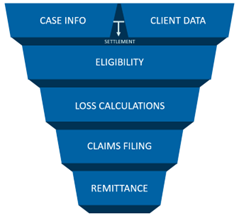
Though not always top of mind for decision-makers, these capabilities represent a clear through-line between operational infrastructure and class action outcomes.
Ultimus Fund Solutions’ IBOR solution provides a consolidated view of positions, cash, and transaction data across custodians and sub-advisors—the same normalized data foundation that determines class action recovery outcomes. Because data resides with the fund administrator rather than any single custodian, lineage is preserved before, during, and after provider transitions.
For firms already working with Ultimus, automated data feeds and straight-through processing eliminate manual data pulls that historically create drag in the class action process and friction when shifting providers. Rather than expecting clients to coordinate with custodians or pay premium fees for historical data retrieval, Ultimus’ shared data pipeline with FRT makes the necessary data available when it matters, at no additional cost.
The results are tangible across three dimensions:
Improved recovery outcomes. Firms that maintain a single book of record for class actions experience fewer rejections, more accurate loss calculations, and higher recovery rates. On average, FRT clients collectively account for 25% of securities class action settlement pools and 40% of SEC Fair Fund distributions (after legal and administrative fees).
Stronger governance. One source of data enables an audit trail for class action recoveries that preserves data lineage across infrastructure and provider migrations. Operations teams have ongoing visibility into filed claims and reporting to better meet regulatory and fiduciary requirements.
Reduced expenses and administrative burden. Onboarding friction decreases when data relationships are already established, allowing investment firms to redirect internal resources toward higher-value operations projects. The costs of recurring class action data refreshes decrease, as well.
Turning Obligation into Advantage
Class actions have long been treated as a responsibility to manage rather than an area that can and should be optimized. The firms that unlock greater recovery performance share a common foundation: consolidated investment data and scalable operational infrastructure that help ensure shareholders receive their full entitlements.
FRT will be sharing additional insights into today’s class action landscape during the Ultimus Client Summit in April, participating in the panel discussion: “From Back Office to Powerhouse: Scaling Investment Operations for Growth.”
COD00001007 4/14/2026